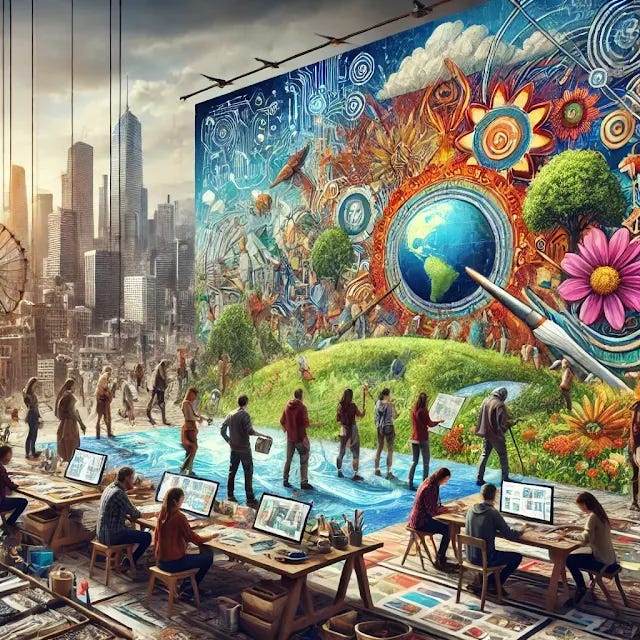
Art news in the current moment reads like a mirror held up to a rapidly transforming world, capturing shifts in culture, politics, and technology through creative expression. Museums and cultural institutions are at the center of this conversation, frequently appearing in headlines not only for major exhibitions but also for structural changes that signal deeper transformation. Around the globe, institutions are reassessing their roles as neutral custodians of culture, acknowledging instead their historical entanglements with colonialism, wealth inequality, and exclusion. This has led to increased efforts toward restitution, with long-disputed artifacts returning to their countries of origin and collections being recontextualized rather than quietly stored away. Exhibitions increasingly foreground overlooked narratives, highlighting artists whose work speaks to migration, race, gender, and memory, while challenging traditional hierarchies of artistic value. Art news also reflects a growing emphasis on process rather than product, with curators and critics paying closer attention to how art is made, who is involved, and what communities are impacted. Large-scale biennials and triennials now function less as showcases of global taste and more as platforms for dialogue, often rooted in local histories and social realities. At the same time, smaller artist-run spaces and alternative venues are gaining recognition for their agility and willingness to experiment, offering a counterbalance to institutional frameworks. This broader visibility underscores a key theme in contemporary art news: the decentralization of authority, where meaning is no longer dictated solely by major museums or critics but emerges from a complex network of artists, audiences, and cultural workers.
While cultural discourse continues to expand, the art market remains a dominant force in shaping headlines, often revealing the contradictions at the heart of the art world. Sales figures, auction records, and collector behavior are closely scrutinized, especially during periods of economic uncertainty, when art is alternately framed as a luxury, an investment, or a safe haven. Recent art news suggests a recalibration rather than a collapse, with collectors becoming more selective and galleries focusing on sustainability over rapid expansion. The dominance of a small group of ultra-established artists persists, yet there is growing interest in mid-career and historically undervalued figures, particularly women artists and artists of color whose markets were long suppressed. Digital transformation continues to redefine how art circulates, with online platforms playing a central role in discovery and sales. What began as a necessity during global lockdowns has evolved into a permanent feature of the art economy, allowing galleries to reach international audiences without geographic constraints. At the same time, ongoing debates around artificial intelligence and generative tools have added new layers to market discussions, raising questions about authorship, originality, and intellectual property. Some artists have embraced these technologies as collaborators or critical subjects, while others express concern about exploitation and loss of creative control. Art news covering these developments often highlights the tension between innovation and ethics, reflecting a market that is eager to evolve but still struggling to define its boundaries. These conversations reveal that the market is not a separate entity from culture but deeply intertwined with the values, fears, and aspirations of the society that sustains it.
Beyond institutions and commerce, art news increasingly focuses on the ways art operates in public and everyday life, reinforcing its relevance beyond elite spaces. Public art initiatives, community murals, performance projects, and socially engaged practices have become prominent features of cultural reporting, especially as cities turn to art as a tool for revitalization and dialogue. These projects often address urgent issues such as climate change, social justice, and collective memory, inviting audiences to engage not as passive viewers but as participants. Education and access are also recurring themes, with artists and organizations experimenting with new models that prioritize inclusivity, care, and long-term impact over spectacle. Art journalism itself is evolving alongside these changes, as writers navigate the pressures of a fast-paced digital environment while striving for depth, accountability, and diverse representation. Independent publications and critics are challenging traditional narratives, broadening the scope of what qualifies as art news and whose voices are heard. This expanded field reflects an understanding that art does not exist in isolation but is woven into the fabric of daily life, influencing how people see themselves and the world around them. Rather than offering definitive answers, contemporary art news documents an ongoing negotiation about meaning, value, and responsibility. In following these stories, readers are invited to consider art not merely as an object of beauty or status, but as a living practice that responds to uncertainty with imagination and to complexity with creativity.
Leave a Reply